Thursday, August 27, 2015

Master Class

Zestful Blog Post #121

When you work at home it’s important to get out of the house now and then. Yesterday Marcia and I went to the Salvador Dali museum in St. Petersburg to see the special M.C. Escher exhibit. As I posted on Facebook and Twitter (yeah, cripe, I actually sent out a couple of real-time tweets), Escher was one of my artistic heroes in college. Indeed, I’m sure his precise methods and mind-blowing illusions are still popular with lots of college kids. Anybody else remember that black-light poster version of ‘Three Spheres’?

The exhibit, on loan through Jan. 3 from the Herakleidon in Greece (yeah, I wonder too) shed more light on Escher for me. I hadn’t known or remembered that he’d been born (1898) into a rich Dutch family, who helped support him as he worked to develop his skills and market his work. He married, had kids, and kept working.

Yesterday I learned that it took him THIRTY YEARS to get his income high enough to support his family adequately. During this time he was frequently depressed due to his lack of financial success. One might expect that he shouldn’t have gotten downhearted, because hey, his parents were behind him, and his kids were assured of food, school shoes, and summer camp.

But I can relate. Anyone who has tried to earn an independent living from art can relate. (Anybody else thinking of Van Gogh right now?) You want to succeed, and income is a sign that your art is making the full circle it’s supposed to make: from you to the consumer, then back to you to make more. Serious artists the world over feel this urgency.

So don’t ever feel greedy or shabby if you yearn for your art to pay off. It means you care.
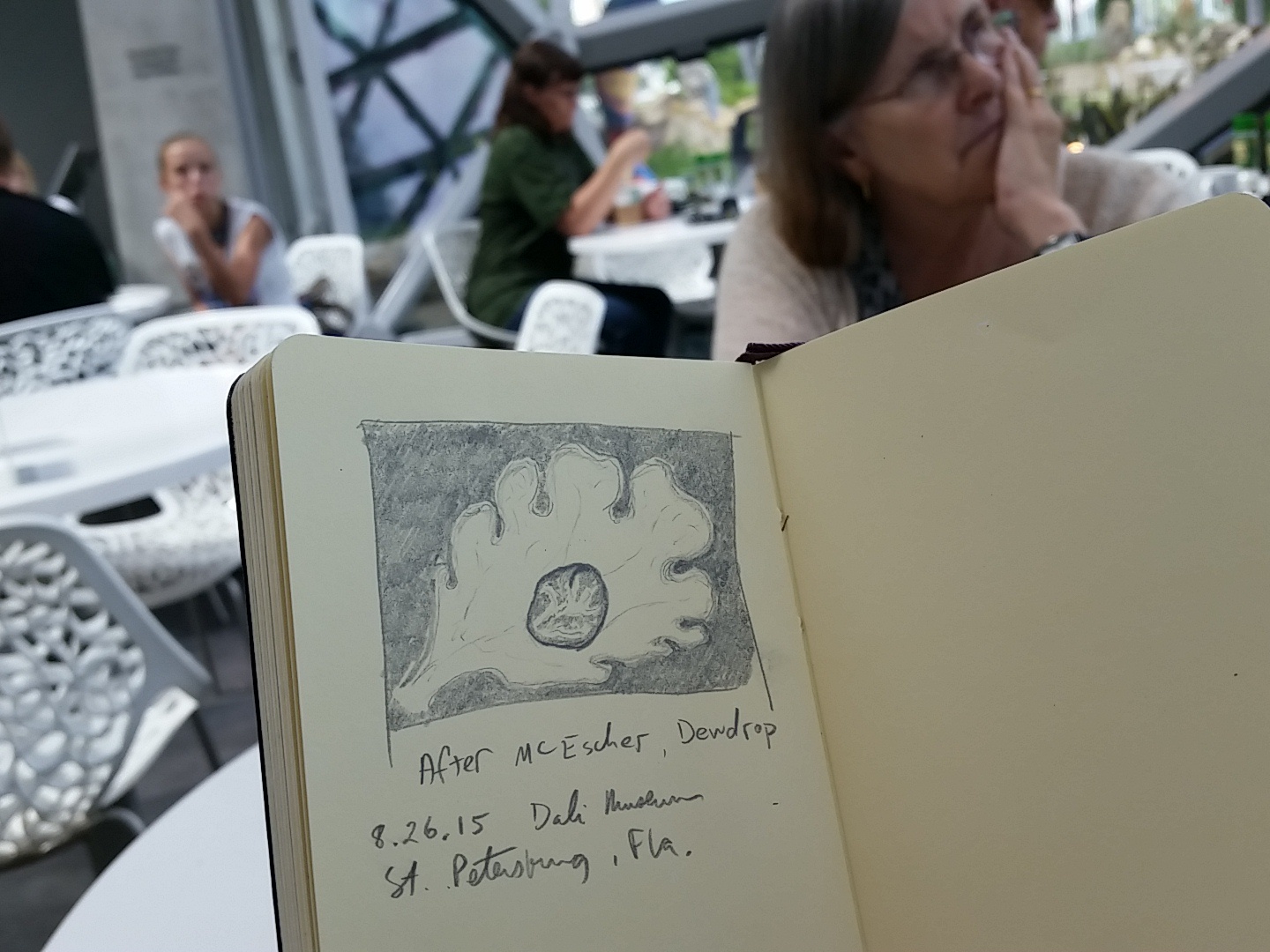


[I always attempt to copy something whenever I go to a museum. My efforts pale in comparison, but I learn something every time. Here I tried to represent the subtle difference of light: It’s falling on the upper edges of the leaf, making them slightly brighter, and leaving the lower edges darker.]

Another thing. Escher loved Italy; he met his wife there, had a child, and found great inspiration in the country’s landscapes. But things got bad under Mussolini. In 1935 Escher moved his family to Switzerland, where his kids wouldn’t be forced to march around in quasi-military uniforms carrying dummy guns. The wintry Swiss landscape felt desolate to him, and his art withered. Until, that is, he decided he’d better stop mourning Italy and look within for inspiration. This triggered his work with plane division, tessellation, and dimensional illusion. And that is what made him a rock star in his own lifetime.

A profound lesson.

What do you think? To post, click below where it says, 'No Comments,' or '2 Comments,' or whatever.

If you'd like to receive this blog automatically as an email, look to the right, above my bio, and subscribe there. Thanks for looking in.

Thursday, August 20, 2015

Stuff That Bugs Me, Vol. II

Zestful Blog Post #120

Point 1:

When I was little and just developing my powers of reason, I’d try to argue with my mother over some abominable requirement, like bedtime at seven-thirty. As all children do, I pointed out that she didn’t have to follow the rule.

“An exception proves the rule,” she’d say smugly, and that was the end of it.

I’d stand there uneasy and baffled, not yet able to express that what she said didn’t make sense. I figured it was some adult, mystical wisdom I’d eventually get the combo to someday.

But here I am, knowing better, yet I keep hearing people use that phrase to excuse or justify whatever contradiction they prefer. God damn it.


[This is me, busily tilting at sloppy usage.]

The real roots of the phrase are ancient. In Roman law, the phrase meant that an exception demonstrates that a rule exists. It did not mean that an exception confirms the rule. But also, one of the several meanings of the word ‘prove’ means to test, or more crudely, find fault with. When you read for proof, you are looking for mistakes.

So, logically, an exception invalidates the rule. Therefore, children should be permitted to stay up until “Lost in Space” is over.

Point 2:

If I hear or read one more news item like, “The report said the cause of the fire was arson, which begs the question: Who would benefit from the loss?,” I’ll run screaming into the desert. Then I’ll shoot myself in the head while throwing myself off a cliff. That should bring me peace, at last.

‘Begs the question’ is the term for a type of fallacy that can also be called circular reasoning. It takes for granted that which is being argued for. Example: I know this document is true because the document says it’s true.

It is nonsensical to use the term ‘begs the question’ when one means ‘prompts the question.’ In fairness, I have in recent months noticed some journalists getting it right. It’s such a great day when I don’t have to drop what I’m doing and sprint into the desert, carrying my .357 magnum and looking for a cliff.

What do you think? To post, click below where it says, 'No Comments,' or '2 Comments,' or whatever.

If you'd like to receive this blog automatically as an email, look to the right, above my bio, and subscribe there. Thanks for looking in.

Thursday, August 13, 2015

Practice the Hard Parts First

Zestful Blog Post #119

When I was a young musician my teacher told me, "Practice the hard parts first." Because it's so tempting, especially for a youngster, to practice the easy stuff and sort of forget about the tough stuff—trusting that somehow it’ll come—until we get caught out in an audition or performance and we stumble exactly where every other loser stumbles.

I’ve ignored that advice to my regret, followed it to my satisfaction, and dispensed it many times over the years. It’s excellent advice for anyone, at any age, who’s dedicated to doing something well.


What do you think? To post, click below where it says, 'No Comments,' or '2 Comments,' or whatever.

If you'd like to receive this blog automatically as an email, look to the right, above my bio, and subscribe there. Thanks for looking in.

Thursday, August 6, 2015

A Drafty Vault

Zestful Blog Post #118

The current issue of Writer’s Digest magazine (August/September 2015) features an article by yours truly called “What Real Revision Looks Like.” My idea was to Show Not Tell aspiring authors different ways to revise, by printing before-and-after excerpts from my own published novels. At 4,000 words, it’s the longest piece I’ve ever done for the magazine, and it was a lot of fun, in spite of the heavy lifting required.


[The dining-room table looked like this for a while.]

Yes, I literally had to do some lifting, in order to retrieve and go through the early rough drafts of my novels, hunting for passages that would illustrate, when compared with the finished, published product, how to recognize manuscript problems and fix them, using elements of good fiction.

I do possess the original handwritten drafts of all my books except for the first, Holy Hell. The very earliest pages of that one I threw out at some point during the 1990s, when I had typed a version onto a diskette (yeah, techno, baby), had minimal storage space in my apartment, and the belief that it would be vain and insane and bad karma to think the manuscript would someday have any historical/scholarly value. But I did some heavy rewriting of it later, and discovered those handwritten pages in the vault. The vault is the place where our house trolls live, beneath the stairs. The manuscripts are in cardboard manuscript boxes stacked in plastic storage totes. None of this is archival, but oh well. Authors, even minor ones, are supposed to keep their original documents and bequeath them to an appropriate archive. I’ve not made this bequest yet, believing it would be vain and insane and bad karma to think my manuscripts will someday have historical/scholarly value. About 10 years ago I read a magazine article that told about some archive that was (at least then) paying ordinary published authors thousands of dollars, like 10 or 15K, for each of their first drafts they wanted to sell. I don’t know if that’s still real.

Like many living authors, the thought that somebody may write their PhD thesis on my work someday is both flattering and disturbing. The dead ones could care less. But hey, how many analyses of Shakespearean slang can the Library of Congress keep track of?

At any rate, it was fun revisiting those old pages—seeing the reams’-worth of yellow pads I used, the different inks—Pelikan Brown looks good against goldenrod paper—from my varied fountain pens and nibs. I mourn the fact that Waterman changed the name of its beautiful Florida Blue to Serenity Blue. Thanks, dudes. Now that I live in Florida I can’t even buy ink with my state name on it.

OK, this is getting too self-referential. About the article for a sec. The most key point is that revision does not necessarily mean cutting material. Yeah, you’ll probably cut some, maybe a ton. But revision is a lot about writing new stuff, to clarify, to make more compelling, to make more magic. I say, during revising: Let it flow, let it flow, let it flow.

Before I sign off, here’s some wonderful news from Diane Dettmann, an early adopter of You’ve Got a Book in You: Her new book, Courageous Footsteps: A WWII Novel, is now available at Amazon, Barnes and Noble and other online bookstores, as well as in bookstores local to her town of Afton, Minnesota.


She’s launching the book locally at an historic ice cream parlor in Afton on August 8 from 2-4. Hustle on over and meet a great gal, check out her intriguing book, and consume mass quantities. Congratulations, Diane!

What do you think? To post, click below where it says, 'No Comments,' or '2 Comments,' or whatever.

If you'd like to receive this blog automatically as an email, look to the right, above my bio, and subscribe there. Thanks for looking in.

Thursday, July 30, 2015

Why we Compete

Zestful Blog Post #117

As it happens, Left Field won a Goldie award (Mystery/Thriller category) at the GCLS conference last weekend in New Orleans. Notice I say ‘a Goldie,’ not ‘the Goldie.’

Everybody knows awards processes are inexact and nervewracking. While waiting for the ceremony to get going, I consumed two martinis (Tanqueray, dry, up, olives), a charcuterie plate, then a plate of lettuce-sashimi wraps, then two pieces of s’mores pie, which I would never do in real life. (The pie.) (It was free.)

As the show started up, I thought about the Olympics, which I avidly watch every time. I always find myself envying, in a way, athletes whose medals depend on empirical measurement (fastest, highest, most goals), and pitying, in a way, athletes who rely on being ‘best’ according to judges. At least in the Olympics the judges have lists of exacting criteria to apply, which help quantify the aesthetics. Not that that eliminates controversy.

But in literature? Articles have been written, letters sent, feuds fought over prizes. Do you remember the shitstorm back in 1987 over Toni Morrison’s Beloved? If you weren’t born yet, that’s OK. The book was shortlisted for the National Book Award but lost to Paco’s Story by Larry Heinemann. Forty-eight black authors wrote an emotional open letter that was published in the New York Times book review, saying that Toni should have won a National Book Award or Pulitzer by then. Lo and behold, a few months later, the Pulitzer went to Beloved. Did that letter have any effect? Who can say?

So last Saturday night my name was announced and I jogged up to the podium and said in part that such things are always a crapshoot, because judging is by definition subjective. And I thanked the judges, which one should always do.

Having been both a winner and loser of literary competitions, and a judge in several of them, I know just how idiosyncratic the process is. You have preferences in style and theme. You might have heard some scuttlebutt about an author that makes you frown—or smile. And how can you decide which piece of art is ‘best’ among a bunch of good ones? But you strive to be impartial, because you have a horror of someone judging your work in a cavalier way. You bear karma in mind. It is what it is.

The GCLS organizers address the inherent-unfairness issue by awarding more than one prize per category, depending on the number of entries/finalists. This dilutes the distinction of the prize and makes the losers feel even worse, but it does exponentially increase winner happiness by letting two or three people go home with


a piece of crystal and bragging rights. The other winners in my category were Anne Laughlin for The Acquittal and Nene Adams for The Consequence of Murder. Congratulations, women!

I might add that this practice also increases the number of times the GCLS is mentioned and discussed. The organization and conference have grown from just a handful of women to many hundreds. This year’s conference attendance was about 350. That’s significant.

Why prizes at all? Because prizes, along with bestseller lists and reviews, are our report cards. They influence customer choice. And that’s why we put ourselves through this imperfect, disquieting process. Yay for me—this time around.

What do you think? To post, click below where it says, 'No Comments,' or '2 Comments,' or whatever.

If you'd like to receive this blog automatically as an email, look to the right, above my bio, and subscribe there. Thanks for looking in.

Thursday, July 23, 2015

New Anthology and a Freebie

Zestful Blog Post #116

Given that not all my blog followers are also signed up for my newschats, I’m putting up today’s newschat here. Apologies if this is a repetition in your inbox, but at least I’m enclosing a shot of the cover of the new antho, which I forgot to do in the newschat.

A few pieces of news from World Headquarters:

1)
I am Calico Jones is a new short e-book from my imprint Spruce Park Press. A collection of four of my short stories, it leads off with my all-time fave, “I am Calico Jones.” If you’re a fan of that fictitious detective whom Lillian Byrd follows so avidly, you’re going to enjoy this. The story originally was anthologized years ago and has been out of print for a long time. Now it’s back!


It’s partnered with a couple more stories that were also out of print forever: “For Faye,” a tale of love, grief, and joyful healing; and “Untold Riches,” the story of a romantic loser who becomes a bank teller and befriends—a thief? Also there’s a new story original to this collection, “Kerchief and Pearl,” which evolved from a short ghost story I made up for a friend and became something completely different. And if you read the collection and like it, I’d be obliged if you’d consider posting a review. If you hate it, just email me privately. That’s the best way, don’t you agree?

The book is available on Amazon, and I might add that you don’t need to own a Kindle to read it; their free app is easy and fabulous.

I might also note that the story “Untold Riches” is available in another new anthology, along with many other quality stories: Lesbians on the Loose: Crime Writers on the Lam, from my good friends at Launchpoint Press.

2)
In honor of Left Field, Lillian Byrd #5, being a finalist for a ‘Goldie’ at this weekend’s Golden Crown Literary Society conference (New Orleans), it’s free on Amazon Kindle now through Sunday. If you haven’t gotten it yet, now’s the time. Rave reviews much appreciated, needless to say. As I write this message, it’s #1 on Amazon’s free list in the Women Sleuths category.

Yes, I’m at the conference. Come up and say hi! Gonna do several panels, a reading, signing, and more. One of the panels I’ll be on will be open to the public: It’s called “Liar, Liar,” and I’ll be trading  autobiographical tall tales with Dorothy Allison, Georgia Beers, Melissa Brayden, and Andi Marquette. Carsen Taite is the moderator, and I guarantee a good time. That’s on Friday afternoon. So local friends, come on down! Dorothy will be giving the keynote on Saturday.

(And in answer to your next question, our housesitter and his twin pitbulls are holding down the fort back in Fla.)

3)
Speaking of Fla., I’ll again be on the faculty of the Florida Heritage Book Festival and Writers Conference September 24-26. I’ll lead a special critique session on Thursday, then on Friday will deliver my electrifying presentation, “Fearless Writing.” The web site has all the info on signing up. It’s a very nicely run conference in the totally cool town of St. Augustine. If you get into my critique group you’ll get a written consult from me on your first 10 pages, plus the opportunity to learn and ask questions all day long.

And I’m sorry about missing the Florida Writers Association’s conference this year, but hope to make it next year.

I love you I love you. XXOO

What do you think? To post, click below where it says, 'No Comments,' or '2 Comments,' or whatever.

If you'd like to receive this blog automatically as an email, look to the right, above my bio, and subscribe there. Thanks for looking in.

Thursday, July 16, 2015

Everyday Scholarship

Zestful Blog Post #115

Recently while killing time in a strip mall, I went into a used bookshop, which started a chain of events that led to this post. I call these events everyday scholarship, and here is the story.

In that shop I came across a 1941 Modern Library anthology of American plays (full cloth binding—God, those were the days) and bought it for a few dollars. Opened it the other day and commenced reading Lillian Hellman’s The Little Foxes, which I’d never read or seen on stage. Not to be confused with The Children’s Hour.

Almost immediately, I felt like I was reading the play in a vacuum. What was the author intending to communicate in this piece, which is set in 1900 and had its premiere in 1939? Even knowing something about the political and social landscapes of those two eras, I couldn’t immediately grasp it.


Briefly, The Little Foxes centers on a well-to-do Southern family not far postbellum, who fight, argue, and scheme against one another. The object of the game is a vaguely described cotton mill and the wealth and power it would bring to whoever owns the largest share.

I already knew Lillian Hellman was decidedly leftist in her politics and thus one might expect that point of view to be advanced in the play. But I wanted some more gloss, so I could be a more acute reader. I searched on line and discovered just the thing: a lengthy review of the play by Elizabeth Hardwick in the New York Review of Books. This review was written in 1967, of a Broadway revival in that same year. Yet another era, with its own social and political context!

Hardwick was pretty scathing, stopping just short of calling the play commie propaganda. But she also compared it against her own standards of good drama. Her main complaints were over-simplified characters (divided into good and bad), and implausible motivation for the key character of Horace. He’s a retired banker, whose money could put the family over the top in their quest to complete the sizable downpayment on the mill.

Horace is against putting money into the mill, and Hardwick questions why a banker wouldn’t recognize the terrific investment opportunity and release the money? I also read the fierce letters to the editor on the review, and Hardwick’s answering of them. Literary feuding at its best! It was almost as good as drinking a martini at the Algonquin.

I finished reading the play expecting to agree with Hardwick’s opinions, and I did agree with some of them, especially her criticism of Hellman’s relentless lefty preachiness. But I felt the Horace character behaved reasonably, given the framework of the play: He recognized that the mill would be run in an avaricious fashion by his crummy brothers-in-law, and while profitable, would not be a force for good.

In this post, I’ve attempted to answer the question: Why should I read literary criticism? Answer: because it makes your brain better, and because it’s a deep kind of fun. When your own curiosity drives you to learn and think, well, it's fabulous. The Web makes it so easy to find viewpoints and counter-viewpoints on practically everything. What an era we live in.

What do you think? To post, click below where it says, 'No Comments,' or '2 Comments,' or whatever.

If you'd like to receive this blog automatically as an email, look to the right, above my bio, and subscribe there. Thanks for looking in.