Thursday, September 17, 2015

5 Things the Queen Did That We Like

Zestful Blog Post #124

I’ve always been grateful for my first name. I’m told my mother considered naming me Marybeth, but my father said, “None of those two-part hillbilly names.” So I got to be Elizabeth Mary. I’ve always felt a little special, because of the Queen, you know. I’ve kept track of her over the years and felt proud that she never betrayed our name by doing anything scandalous or tacky. (Not a word from you about the handbags, not a word.)

When I was a student in London many years ago, the local folks in the pubs loved to debate the issues of the day (and I’m sure still do). A frequent topic was whether the monarchy was a good idea or a bad one, and I witnessed some pretty heated arguments. But when a new round arrived at the table, everybody, and I mean everybody would lift their pints and say in strong voices, “Here’s to the Queen, God bless her.” Then the argument would resume.

I was thrilled, along with millions of Brits, when the Queen last week won the longest-serving-monarch derby, snatching the title from Victoria. Say what you will about the monarchy, Elizabeth was born into it and had no real choice as far as that went. She did have the choice of being a terrific head of state or a crummy one.

Zestful Writing esimsauthor.blogspot.com

[photo by Cecil Beaton ripped off from official Buckingham Palace web site]

So yeah, she:

1)      played the hand she was dealt with courage and grace;
2)      stuck to her role as counsel and support for her various PMs;
3)      weathered, with dignity, horrible personal and family storms;
4)      kept on course through scathing criticism;
5)      yet embraced change when it seemed the right thing to do.

Not a bad way to live a life, whether you’re a writer or any other sort of bloke or blokette.

What do you think? To post, click below where it says, 'No Comments,' or '2 Comments,' or whatever.

If you'd like to receive this blog automatically as an email, look to the right, above my bio, and subscribe there. Thanks for looking in.

Thursday, September 10, 2015

3 Tips for Choosing Deadlines

Zestful Blog Post #123

For professional writers, deadlines are a fact of life. Fortunately, they’ve never daunted me. But I’ve learned a few tricks along the way.

Deadlines fall into two categories: Those imposed on you, and those you have occasion to impose on others. The first kind are set by employers, clients, agents, editors, publishers, etc. Sometimes a deadline is not negotiable. Daily newspapers pretty much have non-negotiable deadlines. If you’re writing freelance, your editor has probably told you a deadline that’s a few hours earlier than the real one, but if you want to keep a good relationship with that editor, you get your piece and pictures in on time.


[You want all of your business relationships to be happy rainbows, not crushed raccoons like the one by the side of the road I Photoshopped out.]

But sometimes, as for a magazine article or a short story for an anthology, you can have a say in your deadline. The conversation might go:

You: So, when do you need this by?
Editor: Well, ideally I’d like it by [X date], but [Z date later] would be OK.
You: Let’s split the difference. How bout [Y date]? Would that really be all right with you?

Because something always comes up, and you’re going to be glad for those extra days. So:

Tip #1: Pad it if you can, but not by a lot. You want breathing room, but you don’t want the job to drag on forever. Plus, bosses like it when you make their lives easier.

Tip #2: Never, if you can help it, choose a deadline that falls on a Monday. Once you’ve made that mistake and paid for it by sacrificing weekend plans, you’ll never make it again. I like Thursday deadlines.

Both of those tips work when you have to impose deadlines as well, like if you’re editing something or arranging for production work to be done, like design and printing.

One more thing, for longer-term deadlines months away, like your next book for your publisher. This also works if you’re the requester of work, like if you’re editing a collection or suchlike:

Tip #3: Never choose a date at the beginning of a month. If you do that, everybody’s like, oh, yeah, we have until February 1st to get that done. And they think February all the way through January, until suddenly it’s like, “Ruh-roh, tomorrow’s February, and it’s not just February, its February 1st, and we’ve screwed ourselves.” But if you pick January 31st, everybody at least starts to bear down in January. “Oh, yeah, January deadline on this one.”

All of this works for self-imposed deadlines as well. It’s all psychological, but real.

What do you think? To post, click below where it says, 'No Comments,' or '2 Comments,' or whatever.

If you'd like to receive this blog automatically as an email, look to the right, above my bio, and subscribe there. Thanks for looking in.

Thursday, September 3, 2015

This Should Make You Feel Better

Zestful Blog Post #122

The other day I was listening to a published author complain about various aspects of our business, like we’re supposed to do social media, blog, write a book every two months, not mind that some jackass who writes cruddy books is really famous and rich, etc. And yeah, one is entitled to complain about anything and everything. But it got me to thinking about my contacts in show business, and how they have it worse than any author who ever lived.

I’m talking about actors and actresses who are not household names, who haven’t played romantic leads, who haven’t won Oscars, but who go out on auditions every day and pretty much take any role they’re offered, be it a character modeling job for an ad photo shoot or a part in a commercial, TV show, or feature film. The journeymen and -women out there who put together a living, sometimes a good living, but sometimes they’re on unemployment.

A favorite story is when I asked an actress friend of mine about the proverbial ‘casting couch’.


[It’s a couch, but it’s the wrong color.]

I’d noticed, when spooking around casting studios doing research for The Actress, that each and every separate studio had a black leather couch on chrome legs, upon which would sit the producer, director, casting director, assistant, and whoever else, in various combinations, to watch the auditions. It was so remarkably consistent: almost identical black leather couches, in casting studios all across Los Angeles.

Which prompted me to ask about the you know, casting couch. My (gorgeous) friend said, “Here’s how it works today. You go to an audition, and the director and everybody are there. You do the audition and they tell you, very nice, thank you very much. Afterward, your agent doesn’t get a call; you do. You get a call on your personal cell phone, and it’s the director, and he says, ‘You did a wonderful job yesterday in the audition! By the way, I’m going up to San Francisco this weekend. Would you like to come?’”

I asked if she ever said yes.

“No. If you do, there’s no end to it.”

Disrespect seems to be the order of business. “They f*ck with you because they can,” said one friend, who had gotten jerked around doing a seven-second shot in a commercial shoot, asked to do it one way, then another, then another, then another. Seven seconds.

Incompetence comes up as well. An actor acquaintance related how he was the principal actor in a TV commercial that was shot over two days. He had been asked to bring his own wardrobe of khaki pants and polo shirt, which he did. After the first day’s shoot, he asked if he needed to bring the same pants tomorrow. The director told him no, just bring the shirt, because the next shots would all be from the waist up.

But when he arrived at the next day’s shoot wearing black pants, they were like, no, man, you’ve got to have the same pants as yesterday! The director had been wrong; they needed to retake some full-length shots. Go home and get em! The film studio was in Santa Monica. This poor bastard lived in Pasadena, 25 miles away. If you have even a passing knowledge of Los Angeles, its traffic patterns and population, you know he was in for probably at least two hours of driving, sitting in traffic, dealing with alternate routes around whichever crashes du jour, etc. He was like, can’t wardrobe come up with something here? And they were like no, you miserable nitwit. Go!

Another time I arrived to have lunch with an actor friend at his house, to find him on the phone, feverishly trying to come up with a jester costume he could borrow from somebody. Because yeah, you’re supposed to costume yourself for auditions (and sometimes even roles, as above), and he wanted this jester role in a commercial, auditions tomorrow. Nobody had an outfit he could borrow. Did he want to rent one for $200? No, man. I believe in the end he bought a jester hat, nailed the audition, and got the part.

It’s a jungle out there.

I’ve never heard of an author being offered a publishing contract in exchange for, well, going along on that weekend to San Francisco, though I suppose it’s not beyond imagination. But really, when we think we have it tough, let’s just remember our friends in Hollywood. May they get residuals for life. And always bring the khaki pants, just in case.

Now for some publishing news from pals around:

Tate Volino, a new local friend, just sent me a copy of his book The Front Nine, a collection of short stories on the golf world. From a first look, I can see the authenticity—behind the scenes at a private club, for instance.

Peter Frickel, another local buddy (with a fabulous South African voice), has been busy publishing on Amazon, most recently Lilies of the Vlei and River, both set in his native continent of Africa.

From Christina Gross, one of my friends from Port Angeles, here’s Rescue the Innocent, a geopolitical thriller with an intriguing plot.

Lastly, buddy BJ Phillips landed a publishing contract with Desert Palm Press for her novel Hurricane Season. Will let you know when that’s available.

What do you think? To post, click below where it says, 'No Comments,' or '2 Comments,' or whatever.

If you'd like to receive this blog automatically as an email, look to the right, above my bio, and subscribe there. Thanks for looking in.

Thursday, August 27, 2015

Master Class

Zestful Blog Post #121

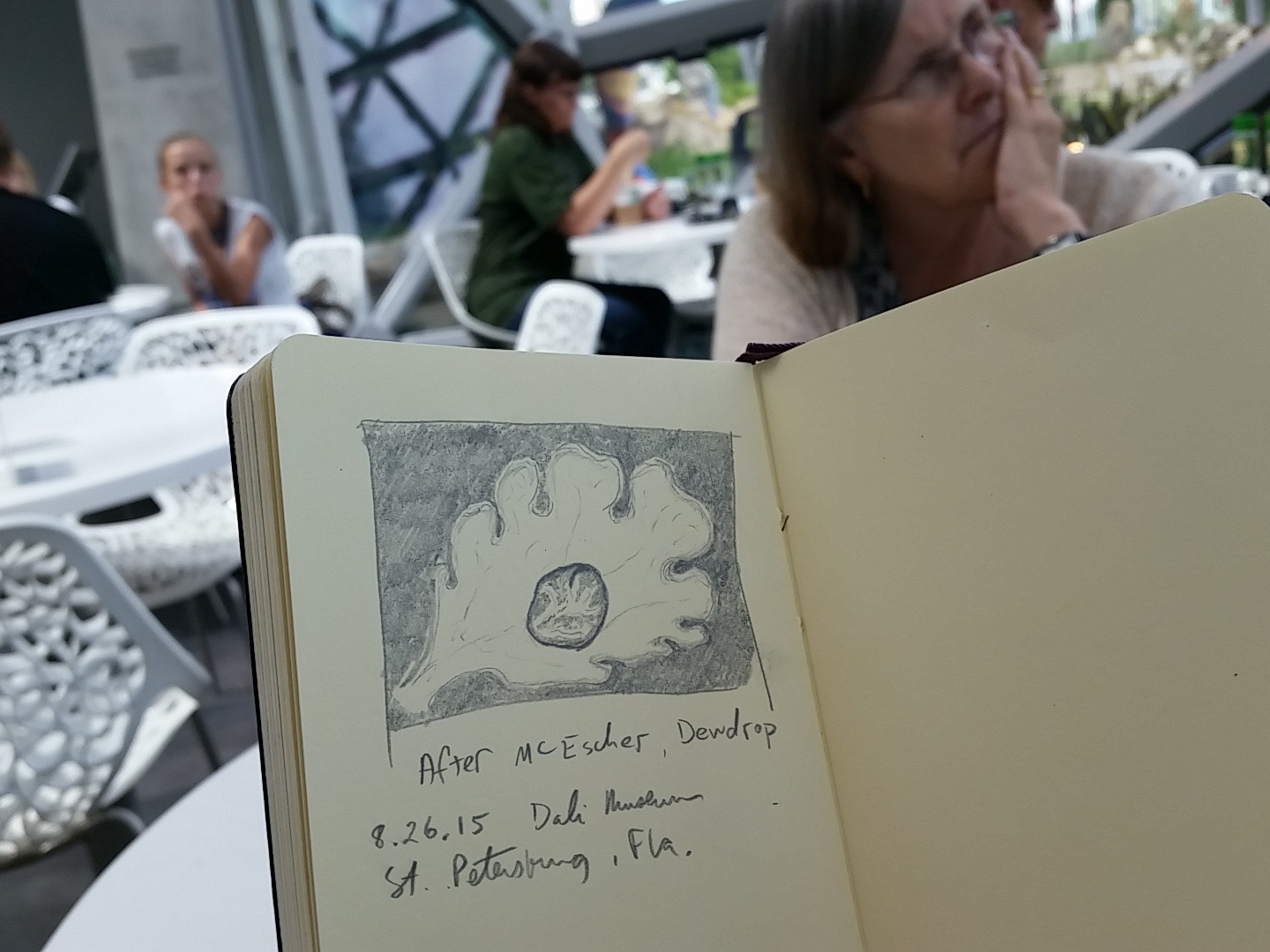
When you work at home it’s important to get out of the house now and then. Yesterday Marcia and I went to the Salvador Dali museum in St. Petersburg to see the special M.C. Escher exhibit. As I posted on Facebook and Twitter (yeah, cripe, I actually sent out a couple of real-time tweets), Escher was one of my artistic heroes in college. Indeed, I’m sure his precise methods and mind-blowing illusions are still popular with lots of college kids. Anybody else remember that black-light poster version of ‘Three Spheres’?

The exhibit, on loan through Jan. 3 from the Herakleidon in Greece (yeah, I wonder too) shed more light on Escher for me. I hadn’t known or remembered that he’d been born (1898) into a rich Dutch family, who helped support him as he worked to develop his skills and market his work. He married, had kids, and kept working.

Yesterday I learned that it took him THIRTY YEARS to get his income high enough to support his family adequately. During this time he was frequently depressed due to his lack of financial success. One might expect that he shouldn’t have gotten downhearted, because hey, his parents were behind him, and his kids were assured of food, school shoes, and summer camp.

But I can relate. Anyone who has tried to earn an independent living from art can relate. (Anybody else thinking of Van Gogh right now?) You want to succeed, and income is a sign that your art is making the full circle it’s supposed to make: from you to the consumer, then back to you to make more. Serious artists the world over feel this urgency.

So don’t ever feel greedy or shabby if you yearn for your art to pay off. It means you care.


[I always attempt to copy something whenever I go to a museum. My efforts pale in comparison, but I learn something every time. Here I tried to represent the subtle difference of light: It’s falling on the upper edges of the leaf, making them slightly brighter, and leaving the lower edges darker.]

Another thing. Escher loved Italy; he met his wife there, had a child, and found great inspiration in the country’s landscapes. But things got bad under Mussolini. In 1935 Escher moved his family to Switzerland, where his kids wouldn’t be forced to march around in quasi-military uniforms carrying dummy guns. The wintry Swiss landscape felt desolate to him, and his art withered. Until, that is, he decided he’d better stop mourning Italy and look within for inspiration. This triggered his work with plane division, tessellation, and dimensional illusion. And that is what made him a rock star in his own lifetime.

A profound lesson.

What do you think? To post, click below where it says, 'No Comments,' or '2 Comments,' or whatever.

If you'd like to receive this blog automatically as an email, look to the right, above my bio, and subscribe there. Thanks for looking in.

Thursday, August 20, 2015

Stuff That Bugs Me, Vol. II

Zestful Blog Post #120

Point 1:

When I was little and just developing my powers of reason, I’d try to argue with my mother over some abominable requirement, like bedtime at seven-thirty. As all children do, I pointed out that she didn’t have to follow the rule.

“An exception proves the rule,” she’d say smugly, and that was the end of it.

I’d stand there uneasy and baffled, not yet able to express that what she said didn’t make sense. I figured it was some adult, mystical wisdom I’d eventually get the combo to someday.

But here I am, knowing better, yet I keep hearing people use that phrase to excuse or justify whatever contradiction they prefer. God damn it.


[This is me, busily tilting at sloppy usage.]

The real roots of the phrase are ancient. In Roman law, the phrase meant that an exception demonstrates that a rule exists. It did not mean that an exception confirms the rule. But also, one of the several meanings of the word ‘prove’ means to test, or more crudely, find fault with. When you read for proof, you are looking for mistakes.

So, logically, an exception invalidates the rule. Therefore, children should be permitted to stay up until “Lost in Space” is over.

Point 2:

If I hear or read one more news item like, “The report said the cause of the fire was arson, which begs the question: Who would benefit from the loss?,” I’ll run screaming into the desert. Then I’ll shoot myself in the head while throwing myself off a cliff. That should bring me peace, at last.

‘Begs the question’ is the term for a type of fallacy that can also be called circular reasoning. It takes for granted that which is being argued for. Example: I know this document is true because the document says it’s true.

It is nonsensical to use the term ‘begs the question’ when one means ‘prompts the question.’ In fairness, I have in recent months noticed some journalists getting it right. It’s such a great day when I don’t have to drop what I’m doing and sprint into the desert, carrying my .357 magnum and looking for a cliff.

What do you think? To post, click below where it says, 'No Comments,' or '2 Comments,' or whatever.

If you'd like to receive this blog automatically as an email, look to the right, above my bio, and subscribe there. Thanks for looking in.

Thursday, August 13, 2015

Practice the Hard Parts First

Zestful Blog Post #119

When I was a young musician my teacher told me, "Practice the hard parts first." Because it's so tempting, especially for a youngster, to practice the easy stuff and sort of forget about the tough stuff—trusting that somehow it’ll come—until we get caught out in an audition or performance and we stumble exactly where every other loser stumbles.

I’ve ignored that advice to my regret, followed it to my satisfaction, and dispensed it many times over the years. It’s excellent advice for anyone, at any age, who’s dedicated to doing something well.


What do you think? To post, click below where it says, 'No Comments,' or '2 Comments,' or whatever.

If you'd like to receive this blog automatically as an email, look to the right, above my bio, and subscribe there. Thanks for looking in.
Thursday, August 6, 2015

A Drafty Vault

Zestful Blog Post #118

The current issue of Writer’s Digest magazine (August/September 2015) features an article by yours truly called “What Real Revision Looks Like.” My idea was to Show Not Tell aspiring authors different ways to revise, by printing before-and-after excerpts from my own published novels. At 4,000 words, it’s the longest piece I’ve ever done for the magazine, and it was a lot of fun, in spite of the heavy lifting required.


[The dining-room table looked like this for a while.]

Yes, I literally had to do some lifting, in order to retrieve and go through the early rough drafts of my novels, hunting for passages that would illustrate, when compared with the finished, published product, how to recognize manuscript problems and fix them, using elements of good fiction.

I do possess the original handwritten drafts of all my books except for the first, Holy Hell. The very earliest pages of that one I threw out at some point during the 1990s, when I had typed a version onto a diskette (yeah, techno, baby), had minimal storage space in my apartment, and the belief that it would be vain and insane and bad karma to think the manuscript would someday have any historical/scholarly value. But I did some heavy rewriting of it later, and discovered those handwritten pages in the vault. The vault is the place where our house trolls live, beneath the stairs. The manuscripts are in cardboard manuscript boxes stacked in plastic storage totes. None of this is archival, but oh well. Authors, even minor ones, are supposed to keep their original documents and bequeath them to an appropriate archive. I’ve not made this bequest yet, believing it would be vain and insane and bad karma to think my manuscripts will someday have historical/scholarly value. About 10 years ago I read a magazine article that told about some archive that was (at least then) paying ordinary published authors thousands of dollars, like 10 or 15K, for each of their first drafts they wanted to sell. I don’t know if that’s still real.

Like many living authors, the thought that somebody may write their PhD thesis on my work someday is both flattering and disturbing. The dead ones could care less. But hey, how many analyses of Shakespearean slang can the Library of Congress keep track of?

At any rate, it was fun revisiting those old pages—seeing the reams’-worth of yellow pads I used, the different inks—Pelikan Brown looks good against goldenrod paper—from my varied fountain pens and nibs. I mourn the fact that Waterman changed the name of its beautiful Florida Blue to Serenity Blue. Thanks, dudes. Now that I live in Florida I can’t even buy ink with my state name on it.

OK, this is getting too self-referential. About the article for a sec. The most key point is that revision does not necessarily mean cutting material. Yeah, you’ll probably cut some, maybe a ton. But revision is a lot about writing new stuff, to clarify, to make more compelling, to make more magic. I say, during revising: Let it flow, let it flow, let it flow.

Before I sign off, here’s some wonderful news from Diane Dettmann, an early adopter of You’ve Got a Book in You: Her new book, Courageous Footsteps: A WWII Novel, is now available at Amazon, Barnes and Noble and other online bookstores, as well as in bookstores local to her town of Afton, Minnesota.


She’s launching the book locally at an historic ice cream parlor in Afton on August 8 from 2-4. Hustle on over and meet a great gal, check out her intriguing book, and consume mass quantities. Congratulations, Diane!

What do you think? To post, click below where it says, 'No Comments,' or '2 Comments,' or whatever.

If you'd like to receive this blog automatically as an email, look to the right, above my bio, and subscribe there. Thanks for looking in.