Thursday, April 17, 2014

Cutting to the Chase


In the last few days, for various reasons, I've been reading a fair amount of unpublished fiction by aspiring writers. I'm happy when either of two things jumps out at me: When an author cuts to the chase, and when they express something with unique style.

What do I mean, cut to the chase?


Simply, get to the point.

There's not just one finish line in a novel, there are a thousand of them. Whenever a character talks, whenever the momentum shifts, whenever the world changes—a rainstorm comes up, an engine coughs and catches, someone feels a surge of love or hate—there's a chase. Cut to it without anything extraneous. The best writers cut to their chases free from fear and eager to let it flow.

Another happy time is when I'm reading a Pulitzer-winning book or the humblest pages from a hopeful writer, and I come across unique expression. Probably happier than when I realize a great plot is unfurling. Both together? I fall on the floor.

Savvy readers instantly recognize terrific style: The words don't just swing, they surprise. You've never thought of dawn light as 'sifting over the land', but when a character does, you go 'Ah.' And you're richer for it. You'd never think to describe somebody's eyes as 'seeds', but when you read it, you experience a tiny burst of pleasure. You've just been helped to see.

The way to write like that is to unleash yourself. Forget any rule about words you ever knew. Go deep, then go deeper on your thousand chases. Your finished words must flow swiftly and smoothly, but you must never hurry.

How do you cut to the chase? How do you excavate your inner stylist? To post your ideas / comments, all of which I read and try to respond to, click below where it says, 'No Comments,' or '2 Comments,' or whatever.


[photo of Robert Garrison's incredible bas-relief embodying swiftness and smoothness at Rockefeller Center by ES] 

If you'd like to receive this blog automatically as an email, look to the right, above my bio, and subscribe there. Thanks for looking in.

Thursday, April 10, 2014

Bones of Mysteries and Thrillers


One of the most popular presentations I give is "How to Write a Dynamite Mystery or Thriller that SELLS." I initially wrote it as a webinar for Writer's Digest, then I adapted it for in-person presentations and workshops, and then I included some of the material in You've Got a Book in You. I'll be giving the presentation in two places this summer, the Golden Crown Literary Society conference in Portland in July and the Florida Heritage Book Festival Writers Conference in St. Augustine in September.

Today's blog is to give you one of the nuggets of that presentation.

When I started out writing fiction seriously, I made a point to read stuff on how to write great fiction or at least fiction that doesn't suck, like writing magazines and interviews of famous authors. And I remember having anxiety about whether my stories were mysteries or thrillers. Why? Because so many writing authorities, including editors and agents, were shouting that you have to write one or the other, and the forms are very different, and you must follow the correct form, or your manuscript will be shoved into the feed box of the monsters that live in the tunnels below Manhattan, because editors and agents require precise categorization of the novels they traffic in, and they have like zero patience.


[Risking my own neck, I captured this image of one of the Manhattan tunnel monsters on a trip to New York recently, so I could prove to you they exist. As you can see, one hand is a catcher's mitt and the other is a Garden Weasel. Terrifying.]

The thing was, every authority's definition of mystery and thriller was different! The formulas seemed complicated, dogmatic, and hopelessly impossible to follow exactly. Anyway, what kind of writer would want to?

It took me a long time to figure out the single basic difference between the two forms:

A mystery is a puzzle.
A thriller is a pursuit.

You just went, "Yeah!", right? Because somehow you knew that already, and it totally fits.

To be sure, most mysteries and thrillers contain some puzzling stuff, plus some getting-chased-by-the-bad-guys stuff. But it's usually more of one than the other, and so there's your category.

Currently, it seems agents and editors (not to mention readers) aren't as hung up on dueling definitions, but they still like to categorize books for the sake of promo and marketing, which is important.

But most important of all is a good story.

Tell us what you think! To post your ideas / comments, all of which I read and try to respond to, click below where it says, 'No Comments,' or '2 Comments,' or whatever.
If you'd like to receive this blog automatically as an email, look to the right, above my bio, and subscribe there. Thanks for looking in.


Thursday, April 3, 2014

Success?


I often talk with aspiring authors and hear their dreams. The drive to succeed as a writer can be almost overwhelming. I've felt it, seen it, and lived long enough to get some perspective.

Remember Olivia Goldsmith? At a meeting of writers in California in the 1990s I heard her talk about how she got a publishing contract for her first novel, First Wives Club.

Distrusting literary agents, she shopped the manuscript around New York herself but nothing came of it. If her manuscript wasn't getting actively rejected, it was languishing in slush piles all over town. As Olivia told it, she was broke and divorced, buying groceries on credit. Yo, bummer.


One night, however, she got a phone call out of nowhere from a young man who had been trolling through one such slush pile. He'd been struck by the manuscript's originality (the revenge of middle-aged wives who've been left for new hotties) and he thought it would make a terrific movie. He'd taken the initiative to pitch the story to filmmakers in Los Angeles, several of whom, he told Olivia, were interested in buying the rights.

Instinctively, Olivia asked which one would pay her the most money.

"Probably Sherry Lansing at Paramount," came the answer.

"That's who I want to talk to," said Olivia.

So the rights got bought and buzz started building. Then and only then did Olivia hear from—guess who???? Major New York publisher after major New York publisher who "remembered that they really liked it!" And somehow, gosh darn it, her manuscript had fallen through some ridiculous crack! And would she be interested in talking it over during lunch today at the Four Seasons?

I admire her for not choosing one of the publishers who'd rejected the book in the first round, but a smaller, less-known imprint (Poseidon Press, div. of Simon & Schuster). The book became a bestseller (1992), and the movie got made (1996). It was a hit, too.

Olivia enjoyed the high life, hobnobbing around New York and Los Angeles, going to the spa, even getting the occasional nip and tuck from the plastic surgeon.

And she kept writing, twelve books in all. Her novels weren't a smash with the critics, but who cares? She was a big-time personality, a New York Times bestselling author. She had made it.

One day in 2004 she climbed onto the operating table to get a little work done on that pesky chin fat. Something went wrong during the anesthetic phase, and Olivia, age 54, never woke up. She was taken off life support after eight days.

When I saw the news item about her premature death, I thought, "Wow. I've spent time envying that woman, and now look. If she could, she'd envy me, because I can at least breathe and walk around."

Beware your own definition of success. The Buddha would tell you you've already made it. Enjoy every minute.

[photo of Times Square by ES]

Tell us what you think! To post your ideas / comments, all of which I read and try to respond to, click below where it says, 'No Comments,' or '2 Comments,' or whatever.
If you'd like to receive this blog automatically as an email, look to the right, above my bio, and subscribe there. Thanks for looking in.


Thursday, March 27, 2014

Generous Writing: What is it?


Occasionally you'll read a book review that says an author was 'generous'. What does that mean, exactly?
Authors can certainly be generous with their subjects. For instance, when you portray a brutish character as also having a sensitive side, that might be called generous. Writing fully fleshed-out characters is also, of course, the mark of a mature author.

But what critics really mean when they praise a work of fiction—or an author—with the term 'generous' is that the author gives us more than he or she has to.


An example makes this crystal clear. Here's a possible character description:

He was a pale guy, not just ordinarily pale, but really extremely pale.

Now read:

There Jerome hung, skinny, sunken-chested, as white as a saltine, his face scrunched up and one hand clutching his nuts. (Jeffrey Eugenides, Middlesex)

or:

There warn't no color in his face, where his face showed; it was white; not like another man's white, but a white to make a body sick, a white to make a man's flesh crawl—a tree-toad white, a fish-belly white. (Mark Twain, The Adventures of Huckleberry Finn.)

You read it, you see it in your mind's eye, you enjoy it, you appreciate it. If you read with fine attention, you're grateful that the writer cared enough to give you something more.

Dull writers cannot be generous; the creativity just isn't there. But if you have any spark of talent at all, and the desire to get good, you can challenge yourself to come up with original ways to describe characters, places, even ideas. How? By taking the time to be there fully with your characters and your scenes. Open your heartbrain and let the world pour in. Take notice, and take risks.

If you do, you'll have a good chance of being the kind of writer readers love without knowing why, the kind of writer savvy reviewers call 'generous'.

[Photo of Marjorie Kinnan Rawlings's desk at Cross Creek, Florida by ES.]

Tell us what you think! To post your ideas / comments, all of which I read and try to respond to, click below where it says, 'No Comments,' or '2 Comments,' or whatever.
If you'd like to receive this blog automatically as an email, look to the right, above my bio, and subscribe there. Thanks for looking in.


Thursday, March 20, 2014

More Now-Ness


Does your pet help you to write? As the Shaggs sang, "There are many things I wonder," and today that's one of them. Prompted by Vicky H., a writer, blogger, and reader of You've Got a Book in You, who tweeted the photo below. Also prompted by Eckhart Tolle, who mentions in one of his books that he's lived with a few Zen masters, all of them cats.


[Photo by Vicky H. Also check out Vicky's blog, www.sleepinginanunmadebed.com.]

In spite of the fact that the protagonist of my Lillian Byrd novels is a pet owner (or keeper, or whatever the current PC term is), I've owned only a few half-assed pets in my day: two sequential parakeets, several sequential turtles, some tropical fish, a chameleon, and gosh, that's it. Oh, plus one time my dad caught a tiny toad in a jar and gave it to me. I had no idea how to care for it, so when it appeared sickly, I let it go in the back yard and told myself it would build a little hut of grass and live happily ever after. But no mammals, other than the mice and bats that lived in past houses. I guess mammals you strive to kill can't count as pets.

I'm told cats like to get extremely up close and personal when you write. Sure, they want attention. But the fact that they're so in the moment (as is, really, every nonhuman animal) must be a boon to a writer, mustn't it? Here's a presence that isn't blocked about anything, isn't worrying about the car insurance bill, doesn't care who wins March Madness (whatever that is), won't waste money on Lotto tickets, and can't fear THE END approaching. Plus being warm and furry. How can that now-ness not transfer to you, the writer, somehow?

Same with dogs, really. They're louder than cats and that's about it, as far as I can tell.

We could all use more now-ness, right? Because it helps the flow.

On to today's stream of consciousness: Writing itself helps free your mind. When I started this post and mentioned the Shaggs, I had a burst of insight, which I put aside until now. It's about the intake of culture. There's so much culture out there vying for your attention, from everything on the web to the magazine rack at the bookstore to ads on the sides of buses. OK, yes, there's so much. There's a ton. There's a billion tons. And I think some of us worry about how to sort and digest it, knowing that you're never going to get all the stuff you probably should get. And my insight is this: Bits and pieces really do work.

To understand outsider art, for instance, simply look into the Shaggs. (I was introduced to them by Susan Orlean's 1999 piece "Meet the Shaggs" in the New Yorker.) You don't need Attwenger or Bill Traylor or Plan 9. Well, you do, but you've got to live your life too. You've got to do what all great outsiders have done: They didn't ingest outsider art, they made their own.

Tell us what you think! To post your ideas / comments, all of which I read and try to respond to, click below where it says, 'No Comments,' or '2 Comments,' or whatever.
If you'd like to receive this blog automatically as an email, look to the right, above my bio, and subscribe there. Thanks for looking in.

Thursday, March 13, 2014

Spring 2014 Newschat


Dearest Blog Friend,

Today I sent out my Spring Newschat, and because you might not be signed up for those, I'm putting the same info here in Zestful Writing.
(Subscribe to Newschats here. They go out 2 to 4 times per year.)

One day in the late '80s, when a particular blockbuster novel was flying off store shelves, I passed an info desk at the large bookstore where I worked. I witnessed this conversation between the store manager, Tim, and the slightly hard-of-hearing employee who shelved the horror section:

Tim: "Jan, do we have any more It?"
Jan: "What?"
Tim (louder): "It!"
Jan: "What?"
Tim (still louder): "Stephen King's It!"
Jan: "Oh! Well, a lot of people think so."

To be sure, these many years later, a lot of people still do think so. Stephen King, that's a guy with a long, prolific career. (An enviable bank account, too, no doubt, though we're only supposed to care about the art…)

Stephen was so prolific because he did a lot of writing. Given that writing takes time, and that the number of hours in a day is finite at 24, it recently occurred to me that Stephen must have said 'No' to lots of stuff that wasn't writing.

And I thought, yeah, man, I gotta say no to more stuff that isn't writing, given that I want to be remembered as an author.


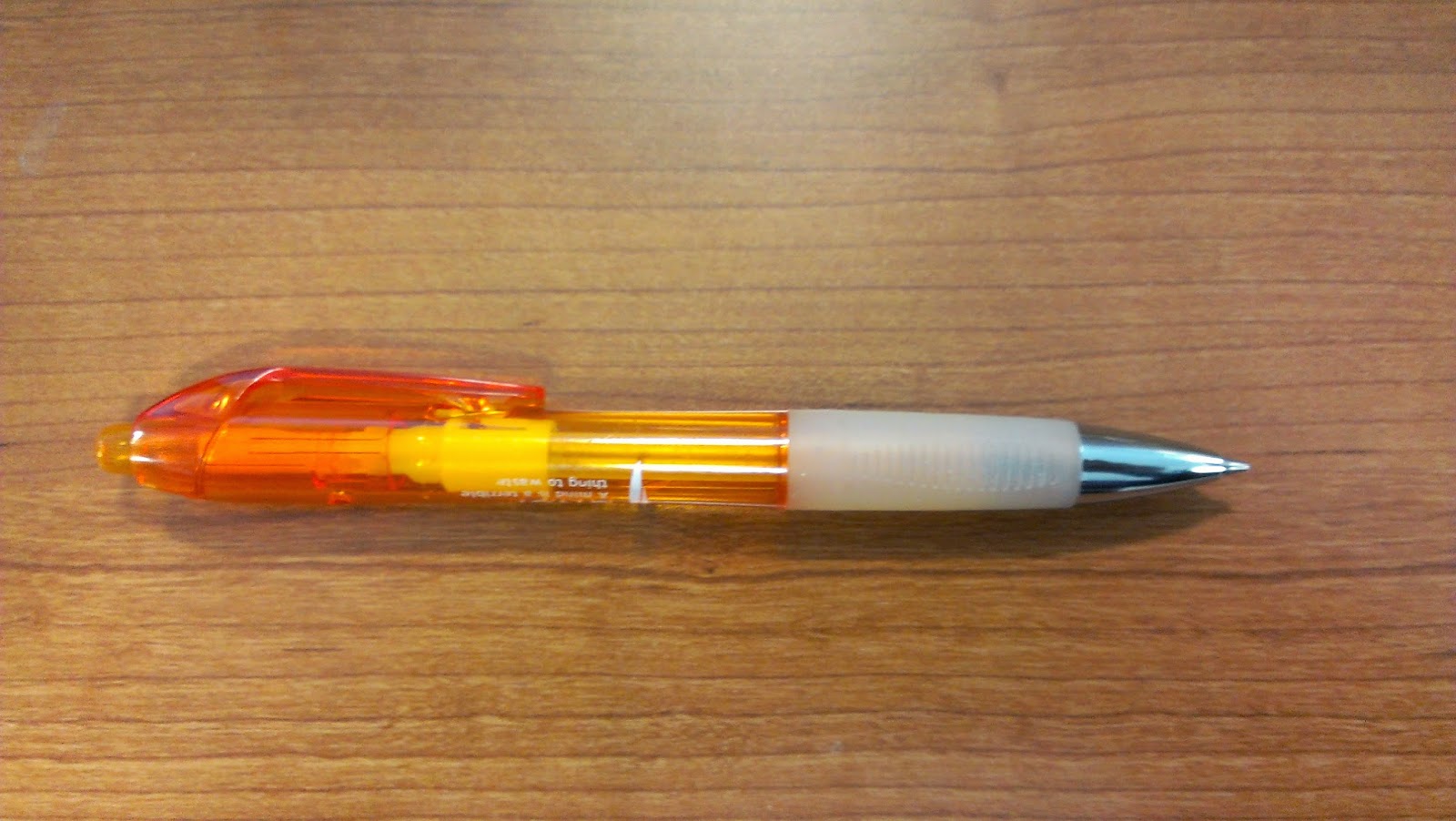
Let this orange pen inspire us all to write and read more! The photo was sent to me by Lidy W., who follows my blog. (www.esimsauthor.blogspot.com) Last week I wrote about some of my favorite writing tools, and she sent this shot of her favorite pen. Love the color.

Now that the main promo push for last year's book, You've Got a Book in You: A Stress-Free Guide to Writing the Book of Your Dreams, is done, I'm continuing work on the next Lillian Byrd novel, Left Field. Given that I really want to finish it and get on to more new writing, I've been saying no to many requests for appearances this year. However, the list of appearances I have said yes to is below.

The most significant opportunity to work with me in person will be the Lambda Literary Foundation's Emerging LGBT Voices Writers Retreat in Los Angeles. Applications are open through April 1. I'll be on the faculty, and my specialty will be genre fiction with emphasis on mysteries and thrillers. We'll have a whole week together in August, doing intensive seminars, small group work, and individual coaching. We'll get in deep on structure, suspense & more. If you write, this is a great chance to make a commitment to your craft.

Watch for an article on writing humor from me in the May/June issue of Writer's Digest magazine; I'll have one on suspense later this year as well.

I should note that You've Got a Book in You is resonating with many writers, and I'm so happy when I hear from them! If you read it, let me know what you think of it.

All dates are in 2014:

Sunday, April 13, 4 p.m., United Methodist Church of Sun City Center, Florida
South Shore Symphony Orchestra concert featuring the works of Aaron Copland. I'll be playing timpani.
www.thessso.org (Website's not quite up to date at the moment.)

Wednesday, April 16, 6 p.m. Nokomis, Florida
Nokomis Volunteer Fire Department, corner of Pavonia and US41
Nokomis, Florida. I'll be speaking and doing Q & A.
For information, email George Mindling at myakka@embarqmail.com, or Ed Ellis at edellis20@gmail.com. Please include FWA Sarasota in the subject line.

April 27, April 29, March 4
Tampa Bay Symphony concerts featuring Dvorak's "Carnival Overture", Beethoven's Piano Concerto #3, de Falla's "Three-Cornered Hat" suites. I'll be playing percussion.

July 9-13, Portland, Oregon
Red Lion Hotel On The River - Jantzen Beach
The 2014 GCLS Conference (Golden Crown Literary Society)
I'll be attending and possibly presenting a workshop.

August 3-10, Los Angeles, California on the campus of the American Jewish University (AJU).
Elizabeth Sims, Faculty - Genre Fiction (emphasis on mysteries and thrillers)

Saturday, September 6, 10 a.m., Tampa Florida
New Tampa Library
10001 Cross Creek Boulevard
Tampa, FL 33647
813-273-3652
I'll be speaking and doing Q & A. For information, email Cindy Campbell at abic@msn.com.

September 25-27, St. Augustine, Florida
I'll present 'How to Write a Dynamite Mystery or Thriller that SELLS' (day/time TBA)

With thanks for reading, and wishing you a fruitful, zestful Spring,

Elizabeth Sims

Tell us what you think! To post your ideas / comments, all of which I read and try to respond to, click below where it says, 'No Comments,' or '2 Comments,' or whatever.
If you'd like to receive this blog automatically as an email, look to the right, above my bio, and subscribe there. Thanks for looking in.

Thursday, March 6, 2014

The Romance of Tools


I've had questions 'off-blog' about the group of writing instruments in Zestful Writing's heading picture. From left:

1) A Fisher Space 'bullet' pen, perfect for pocket, purse, or wetsuit. Developed for the US space program, it writes reliably under any conditions. I believe because the cartridge is under slight pressure, the ink tends to form a blob at the end of the ballpoint between uses.

2) A blue gel pen, either SARSA brand or Pilot brand, can't remember which. I like these for travel, and as backups when my fountain pen runs dry when out and about. SARSA is the smoothest I've found.


3) Lamy Safari Vista fountain pen, medium nib. Cheap (c. $30) but good. I like being able to see the ink level in the reservoir. I got this pen for writing in cafés after, lost in the fog of chapter 10 or 12 or 39, I made the nearly fatal mistake of leaving my prized Mont Blanc (not pictured) on the table when I went to the bathroom. When I returned I saw the guy at the next table staring at it steadily. I could read his face with ease: I want it. Should I? What if I did?

4) One of my best pens is this Parker Duofold in pearl and black. I bought this one in San Francisco when I left my day job to be a writer. The feel of the thing is wonderful: the material of the barrel is warm and remarkably smooth in your hand, and the gold nib glides across paper smoother than anything. In retrospect, this one's a bit gaudy, but it delivers everything it promises.

5) Faber-Castell TK Fine Vario, 0.7mm. I love pencils, especially mechanical pencils, ever since my big sister showed me hers as she did her awesomely complicated-looking high-school math homework. The barrel was translucent red, as I remember, and I thought it was the coolest thing in the world. A few years ago she mentioned that her current favorite was the TK Vario, so I bought one. I find the polished steel grip a bit slippery, but I like the looks of the pencil so much that I reach for it all the time. I like the cushioning spring (mine's set to soft) and I like the exposed, twist-advance eraser.

6) Staedtler Mars-Lumograph wood pencil, 3B. From my drawing kit. The leads in these are incredibly smooth and beautifully bold and dark.

7) Staedtler white plastic eraser—the best.

8) Brass barrel sharpener stamped 'West Germany'. Sharpens great and feels so heavy and perfectly machined that you want to keep it in your pocket at all times.

What are your favorite writing tools?

[photo by ES]

To post your ideas / comments, all of which I read and try to respond to, click below where it says, 'No Comments,' or '2 Comments,' or whatever.

If you'd like to receive this blog automatically as an email, look to the right, above my bio, and subscribe there. Thanks for looking in.